The challenge
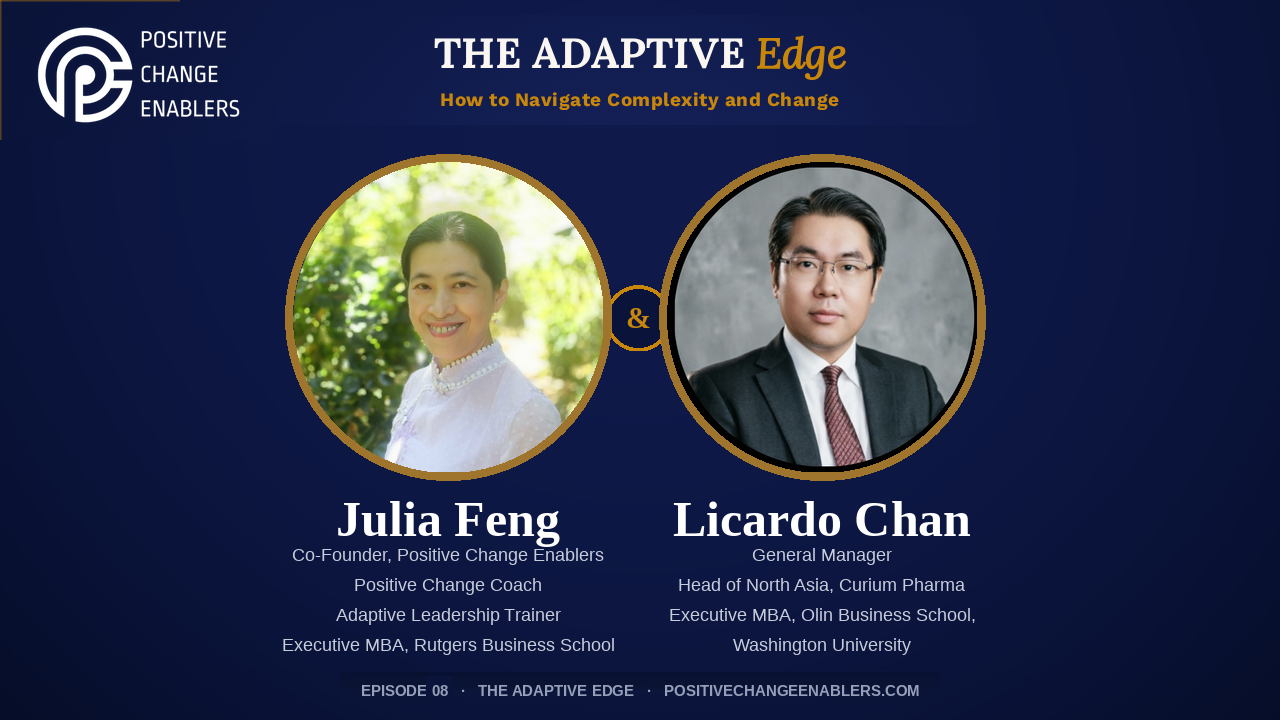
Licardo Chan was a strategy leader at a multinational pharmaceutical company when he moved into a newly created role: head of new product launch for China. Many of the company's products had lost patent protection, and competitors were bringing new products to market within three to six months of regulatory approval. Licardo's own company needed one to two years.
His general manager gave him a target that sounded like a joke: launch the first product in three months, or be fired. Licardo took a few seconds, then said yes. In September 2018, the product launched in 58 days.
This was not a technical problem with a known fix. It meant changing how dozens of people across departments, and manufacturing sites around the world, worked together. That is what we call an adaptive challenge, and it is a good place to see the nine core skills of The Adaptive Advantage in action. Licardo did not use our framework. He simply did what effective leaders do, and the skills are visible in what he describes.
"Every single issue can be further broken down. If you are able to eat it bit by bit, at the end of the day you will be able to solve it."
The nine skills in his story
Phase I: Diagnose
Seeing the patterns that others miss.
Skill 1
Systems Thinking & Inter-connectedness
Launching a product touched regulatory affairs, packaging, logistics, production, and global manufacturing sites. Licardo mapped the whole process rather than pushing each department separately. Looking at it as one system revealed that some tasks believed to be sequential could run in parallel, and some were duplicated. He also saw that half of the critical path sat outside China, in the hands of global sites, which is why he later flew there himself.
Skill 2
Keen Observation (Getting on the Balcony)
Before he asked anyone to move faster, Licardo stepped back from the daily work. He benchmarked how long each stage took at competitors and compared it with his own company's process. Then he invited every function to a week-long workshop to find out why the gap existed. Starting with the real problem definition, not a fix, is the balcony view: seeing the pattern before reacting on the dance floor.
Skill 3
Emotional Literacy (Reading the System's Mood)
The room was defensive at first. People said the target was too daunting and that they were already following the procedures. Licardo read this as a signal about the mood of the group, not as a verdict on feasibility. He also learned to sort his team into the rational, the emotional, and the free riders, and to find out the hidden agenda behind each, ideally in one-to-one conversations before the workshop.
Phase II: Mobilize
Engaging the system to take ownership of the challenge.
Skill 4
Active Listening (Listening for Loss)
"We are just following the procedures" can sound like resistance. Behind it, there is often something people fear losing: safety, competence, or the protection of doing it by the book. Licardo did not argue with the procedures. He treated each step as worth examining and let people discover for themselves where time could be saved. This is our reading of the story, and he describes the pattern in his own words: when people face something unfamiliar, their first instinct is to say no.
Skill 5
Framing & Purpose
Licardo reframed the work. The team was not competing against itself or the procedures. It was competing against other companies for a market where being first matters. That gave the struggle a purpose beyond a manager's demand. When he met the global manufacturing head, he told the story of an ancient general who crossed an impossible distance in days because he believed there was always a way, and it opened the conversation.
Skill 6
Powerful Questioning (Giving the Work Back)
Licardo did not hand down a new process. He put the benchmark on the table and let everyone raise their own ideas: why can't we meet this, and if we could, what support would we need? He dissected each step with the owners of that step. The solutions came from the people who would carry them out, which is why they stuck.
Phase III: Intervene
Driving change while maintaining stability.
Skill 7
Conflict Facilitation (Productive Disruption)
Licardo describes the week as full of internal debate, and calls it constructive. He did not smooth over disagreement. He kept the heat in the room and pointed it at the problem. The same applied overseas: the manufacturing head told him he was the most pressing and aggressive person he had worked with from China, and Licardo kept the dialogue going until it became joint problem-solving.
Skill 8
Self-Regulation (Staying Grounded in the Storm)
Hearing "you will be fired if you fail" would unsettle most people. Licardo took a moment, weighed the worst case (losing the job), weighed the best case (a major upgrade in his own capability), and chose. He credits a consultant's habit of breaking big questions into small ones, which kept him calm enough to lead a room that was telling him no. His advice: if you think you have better than 50 percent odds, take the stretch.
Skill 9
Political Savvy & Coalition Building
Cutting the lead time in China was only half the work. Licardo travelled to the global manufacturing leadership with the workshop results in hand, persuaded them, and had production, packaging, and logistics teams working with him within weeks. His own lessons are pure coalition building: know each stakeholder's agenda, win over supporters early, recognize contributions immediately and authentically, and give people room to fail.
What this means for you
Notice that Licardo did not rely on one heroic skill. He diagnosed before he acted, mobilized the people who owned the work, and held steady while the system pushed back. That sequence is the shift from Heroic Solver to Strategic Mobilizer, and it is exactly what the nine modules of The Adaptive Advantage are designed to build.
As you watch or re-watch the conversation, try this: pick one adaptive challenge you are facing now, and ask which of the nine skills Licardo used that you are not yet using.
This article is our interpretation of Licardo's story, based on his conversation on The Adaptive Edge Podcast. The framework names are ours; the events and lessons are his.