The story
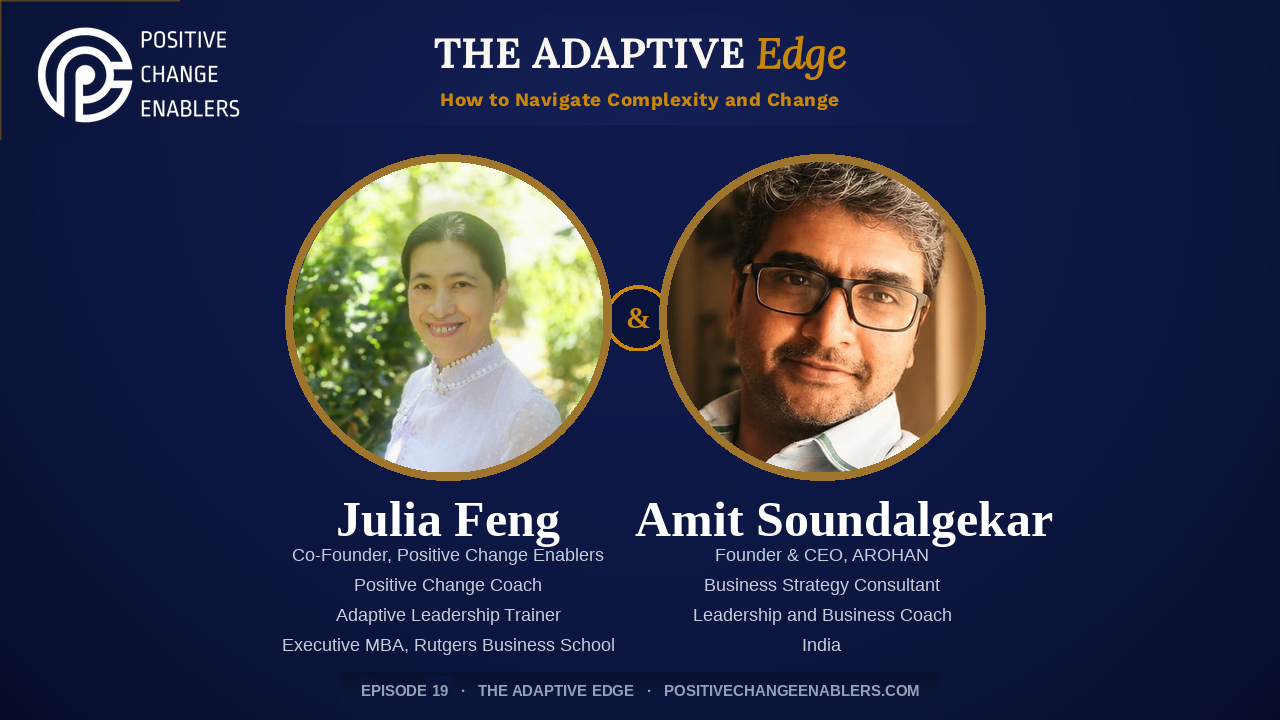
Amit Soundalgekar is Founder and CEO of AROHAN in India, a business strategy consultant and a leadership and business coach, and an organic farmer. Over more than thirty years he has moved from sales into a water treatment business, then into consulting, coaching and facilitation, and later into farming.
Each move took him into the unknown. “Complexity in your life does not announce itself,” he says. His answer is not more control, but simpler questions.
“Gravitate towards simplicity to deal with complexity.”
The skill at work: Powerful Questioning (Skill 6)
Powerful Questioning is the skill of asking the question that opens up thinking, rather than handing out answers. In The Adaptive Advantage we also call it Giving the Work Back: trusting people to work out their own solutions, so the leader is not the bottleneck. Amit's story is strongest on asking the right question about the problem and on giving the work back.
The wrong problem
His first water softener business failed. The equipment design did not suit the local water. “I was actually solving a wrong problem,” he says. The technology worked; the question he had been asking did not.
Study, reflect, apply, repeat
Instead of a ready answer, he went back to questions. He studied the design, reflected on whether it would work, applied it, found the next fault, and repeated the cycle until the business did well. He uses the same cycle on his farm. “You don't need to start with solutions in mind.”
Don't wait too long
Waiting too long between reflection and application, he says, takes you back to complexity, because overthinking sets in. Take the first step, and solutions start to emerge.
Giving up control
Most of our day goes on small decisions, and decision fatigue leaves little energy for big ones. Amit noticed that wanting to be part of every small decision comes from the need to control. So he gives others the freedom to work their own way. “It gives me the freedom to work my way.”
From what and how to why
When you focus too much on the what and the how, he says, you stay with immediate reality. The people around him work out the what and how; his job is to reflect on the why. He admits he still gets pulled into small decisions, and has to keep reminding himself.
The right question works both ways
At the end of the interview, after putting his purpose into words, Amit said: “You did ask me the right question.” A good question helped him find the words.
Try this
This week, when someone brings you a small decision, ask: “What would you do?” Then let them do it. Use the time you save to ask yourself one why question about your work.
Another story of this skill
Giving the Work Back: Jack Carney's story of Powerful Questioning →
This article is our interpretation of Amit Soundalgekar's story, based on the conversation on The Adaptive Edge Podcast. The framework names are ours; the events and lessons are his own.