The story
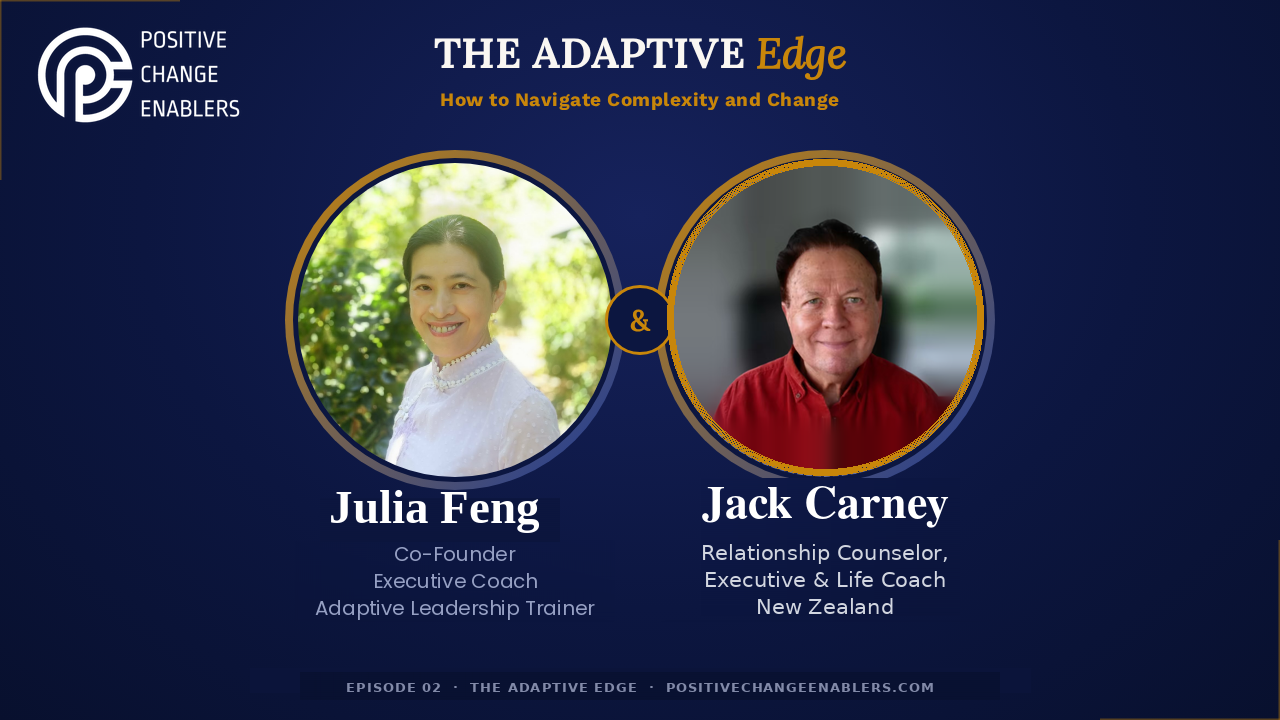
Jack Carney is a life coach and consultant who taught and worked with managers in China for many years. When asked what comes to mind about navigating complexity and change, he does not offer a method to apply from above. He talks about self-organization and trust: trust in yourself first, and then trust in the people you work with, so that you do not micromanage them.
He is blunt about it. In his view there are more damagers than managers in the executive field. His alternative is to treat complexity as emergent, something that cannot be planned directly, and to create the conditions in which good solutions can emerge from the people closest to the work.
“Paying attention to the relationship rather than trying to order and control the behavior.”
The skill at work: Powerful Questioning (Skill 6)
Powerful Questioning is the shift from Answer-Provider to Insight-Generator: giving the work back to the team so that accountability grows and problems stop travelling upward. Jack does not describe it in those words, but his whole approach to managing is built on it.
Trust instead of micromanaging
The starting point is trust. If you give people freedom and responsibility, you do not need to hold every decision. A leader who answers everything keeps the team dependent. A leader who trusts the team gives the work back.
Helping each person find their own way
Jack insists that every person is unique and that a manager cannot assume everyone organizes their work in the same way. The manager's job is to coach, to help each person find their own way to organize and sort the problem, and to trust that they can.
Enriching the environment, not instructing
He draws on the Montessori approach: the teacher does not so much teach as provide good material and trust that the learner knows how to learn. At work this means giving people books, papers and tools such as AI, and then stepping back to see what emerges.
Relationship over behavior
In any situation you can fixate on controlling behavior, or you can pay attention to the relationship you have with the person. He argues the second approach is what makes honest conversation possible, including the kind of honest negative feedback that many workplaces avoid.
Inviting mistakes and honest answers
Jack says everyone should make a mistake at least once a day, and that part of his work in China was to encourage people to say when they did not understand or did not like something. Asking people to tell you what they really want, and treating mistakes as learning, is the culture in which questions get real answers.
Using AI as a sounding board
His advice on AI is also about questions: learn to prompt well, and even ask the AI to give you prompts back. Describe a stuck situation, such as a touchy employee, and ask for feedback. The tool becomes a partner in thinking, not a source of answers.
Try this
Think of a problem a team member brought to you recently. What question could you have asked instead of giving the answer, so that the work went back to them?
Another story of this skill
Solving the Right Problem: Amit Soundalgekar's story of Powerful Questioning →
This article is our interpretation of Jack's story, based on the conversation on The Adaptive Edge Podcast. The framework names are ours; the events and lessons are his own.